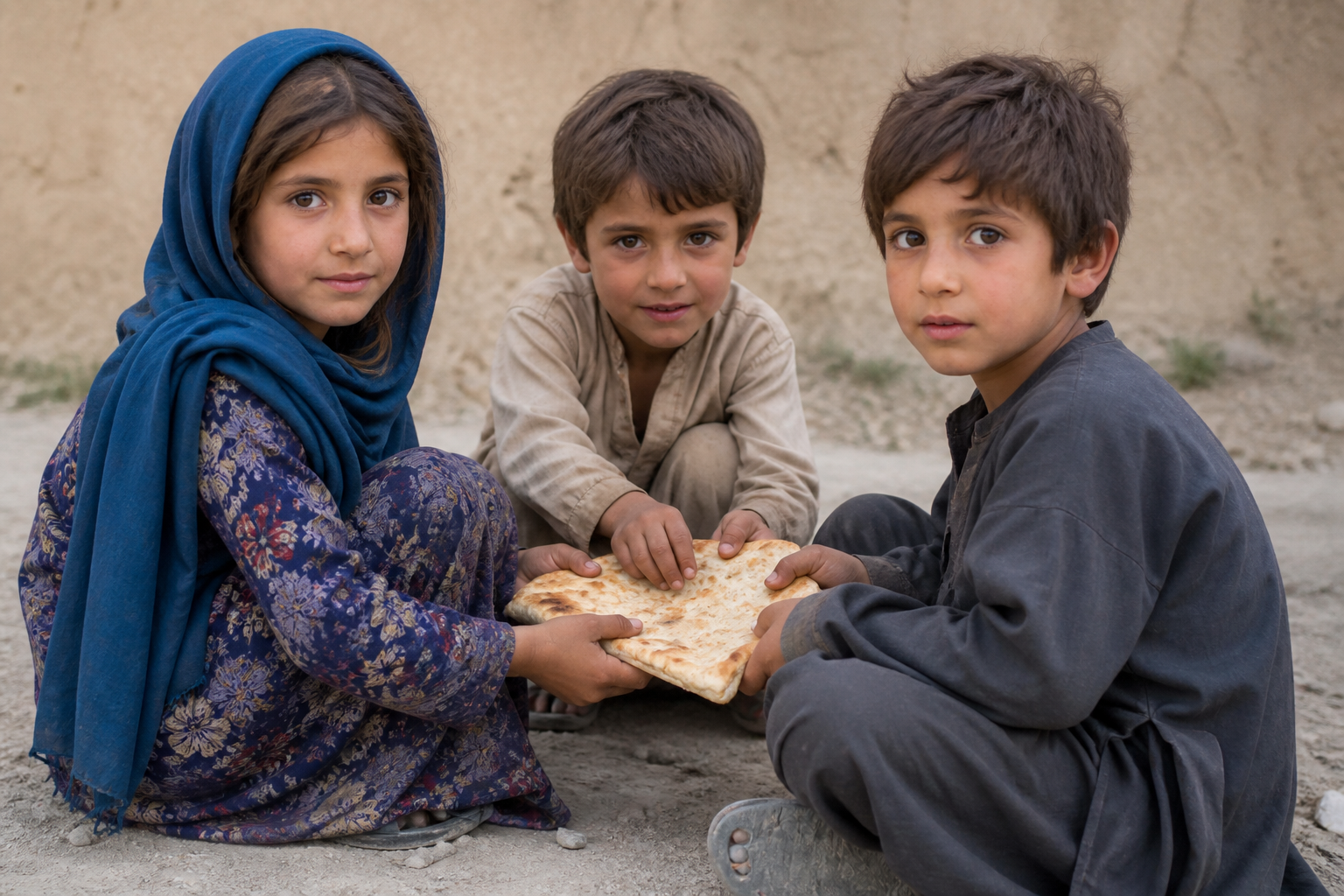
Hunger is a daily reality
Millions of people in Afghanistan face acute food insecurity. Parents skip meals. Children go to bed hungry. A single food package can change the course of a family's week.

Why This Matters
This page is not about politics or religion. It is about mothers, fathers, elders, and children facing hardship no one deserves.
Faces of the need
Women. Elders. Men searching for work. Children who did nothing wrong. Poverty is not a statistic when it has a human face.
Mothers & families
Women carrying households through hunger, cold, and uncertainty — with quiet courage.

Children
Young lives that should be filled with play and learning — not empty stomachs.

A generation waiting
Crowds of children in dusty fields — a reminder of how many futures hang in the balance.

Elders & everyday need
Hands that once provided for others now wait for a meal, medicine, or a little warmth.
Graphical analysis
These charts use public humanitarian and economic data so you can see how widespread hunger, poverty, and joblessness are. Behind every bar is a family.
Figures reflect public reports from late 2025 – mid 2026
17.4M
People in acute food insecurity
Nov 2025 – Mar 2026 (winter lean season)
21.9M
People needing humanitarian aid
About 45% of the country (2026)
3.7M
Children under five with acute malnutrition
Plus 1.2M pregnant & breastfeeding women
Roughly one in three people face crisis-level hunger in the lean season. Nearly half the country needs humanitarian assistance.
Acute hunger
17.4 million people — IPC Phase 3 or worse during winter.
Need aid
21.9 million people projected to require humanitarian assistance in 2026.
In poverty
Approx. share living in poverty (World Bank, Spring 2023 baseline still widely cited)
During the winter lean season, 4.7 million people are projected to face emergency-level hunger (IPC Phase 4) — the most severe category short of famine.
Emergency hunger (IPC Phase 4)
4.7M
Crisis hunger (IPC Phase 3)
12.7M
Not in acute crisis (estimate)
25.6M
Lean season — people in crisis or worse
17.4M
Nov 2025 – Mar 2026 (winter lean season)
Harvest season — projected (still severe)
13.8M
Apr – Sep 2026 (projected)
Official unemployment does not capture the full picture. Many people work informally or not at all — and still cannot provide basic necessities for their families.
Population living in poverty
48%
Unemployment (ILO modelled estimate)
13.4%
ILO modelled estimates understate underemployment and unpaid hardship — many educated adults still cannot earn enough to feed a family.
Youth unemployment (ages 15–24)
16.8%
The human reality
The charts show the scale. These moments show the people living inside it.
Millions of people in Afghanistan face acute food insecurity. Parents skip meals. Children go to bed hungry. A single food package can change the course of a family's week.
Many skilled and educated people — teachers, professionals, tradespeople — struggle to find paid work. When income disappears, dignity and hope disappear with it.

Harsh winters turn scarcity into emergency. Families need warm clothing, blankets, and fuel support simply to survive the cold months.
When households cannot afford food or medicine, children suffer first. Helping a family is protecting a child's tomorrow.
Reliable information
For ongoing reporting on food security, livelihoods, and emergency need, we encourage readers to consult organisations such as the World Food Programme (WFP), UN OCHA, and UNICEF. Their public situation reports help us stay grounded in verified need — while our mission stays focused on dignity and direct help.
Knowing the need is only the beginning. Meeting it — together — is the mission.
Walk this journey with me
No amount is too small. Every gift is a meal, a warmer night, and a gentle reminder: you are not forgotten.
A meal can mean everything.
Give hope